
This event has passed.
HPC Society January 2025 Lunch & Learn
January 30 @ 11:30 am - 1:00 pm
Cost:
Free – $10.00
Society of HPC Professionals lunch and learn event, including tour of TACC supercomputing facility
Scientific Machine Learning in Advanced Manufacturing
George Biros, Ph.D. – Professor and W. A. “Tex”‘ Moncrief Chair in Simulation-Based Engineering Sciences, University of Texas Austin
- 11:30am- Noon CDT — Networking
- Noon – 1:00pm CDT — Presentation (+ online option)
- 1:00pm – 1:30pm CDT — Tour TACC Supercomputer Center (optional)
About the Event
Predicting grain formation during alloy solidification is of great importance in additive manufacturing (AM). Numerical simulations require fine spatial and temporal discretizations that can be computationally expensive. In this talk, I will discuss GrainNN, an efficient and accurate reduced-order model for epitaxial grain growth in additive manufacturing conditions. GrainNN is a sequence-to-sequence long-short-term-memory (LSTM) deep neural network that evolves the dynamics of manually crafted features. We present results in which GrainGNN can be orders of magnitude faster than phase field simulations, while delivering 5%–15% pointwise error. This speedup includes the cost of the phase field simulations for generating training data. GrainGNN enables predictive simulations and uncertainty quantification of grain microstructure for situations not previously possible.
About the Speaker
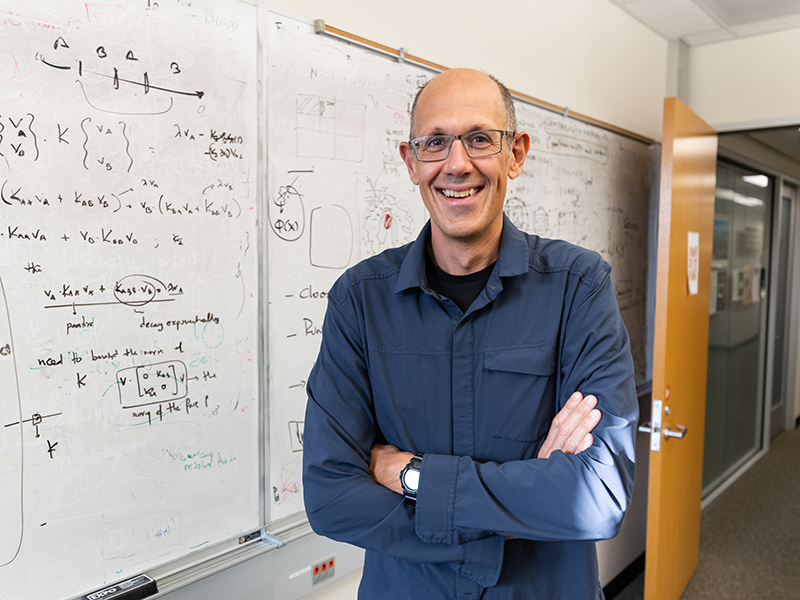
George Biros, Ph.D. – Professor and W. A. “Tex”‘ Moncrief Chair in Simulation-Based Engineering Sciences
Predicting grain formation during alloy solidification is of great importance in additive manufacturing (AM). Numerical simulations require fine spatial and temporal discretizations that can be computationally expensive. In this talk, I will discuss GrainNN, an efficient and accurate reduced-order model for epitaxial grain growth in additive manufacturing conditions. GrainNN is a sequence-to-sequence long-short-term-memory (LSTM) deep neural network that evolves the dynamics of manually crafted features. We present results in which GrainGNN can be orders of magnitude faster than phase field simulations, while delivering 5%–15% pointwise error. This speedup includes the cost of the phase field simulations for generating training data. GrainGNN enables predictive simulations and uncertainty quantification of grain microstructure for situations not previously possible.