
HPC-AI Society March 2026 Lunch & Learn
The HPC-AI Society Lunch and Learn Event — Texas Advanced Computing Center (TACC)
Large Data Filtered Through an Artistic Hand
Francesca Samsel - TACC
- 11:30am- Noon CDT – Networking
- Noon – 1:00pm CDT – Presentation (+ online option)
Members: To select your member ticket, please log in and revisit this page.
About the Event
The Art-Sci-Vis Lab (ASV) is a joint lab between the Texas Advanced Computing Center (TACC) and the University of Texas, Austin, and a sub-group of TACC’s larger visualization team. The lab’s ethos are rooted in the philosophy that the arts and the sciences are equally deep, rich, and significant disciplines that shape and influence modern society’s endeavors.Their research therefore considers how, for example, expertise from the arts improves the analytical practice and communicative capability of multivariate, volumetric visualizations of environmental systems, or how insight into biogeochemical processes might improve environmentally-focused public art.
As a research scientist at the Texas Advanced Computing Center, University of Texas at Austin, Francesca Samsel, trained as an artist, works with multi-disciplinary teams, creating an artistically-driven visual vocabulary for scientific visualization. She got her start as an artist-in-residence at Los Alamos National Laboratory where she spent ten years using her design training to help scientists extract relevant content from their large scientific data simulations and communicate across audiences. In this presentation, she will be showing this work as well as more recent content of humanizing the presentation of climate science.
Stay after the presentation for a VIP tour of the Art-Sci-Vis Lab to see the research.
Download presentations and/or watch videos
About the Speaker
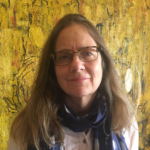
Francesca Samsel - TACC
Francesca Samsel is an artist and research scientist whose work bridges art, science, and visualization. She is a Research Scientist at the Texas Advanced Computing Center at the University of Texas at Austin, where she collaborates with scientists, engineers, and visualization researchers to develop an expanded visual languages for exploring complex scientific data.
Trained as a visual artist, Samsel brings principles from painting, printmaking, and design into the field of scientific visualization. Her research focuses on expanding the visual vocabulary used in data visualization—developing color palettes, glyphs, textures, and compositional strategies inspired by nature and artistic practice to help scientists more clearly perceive patterns within large, multivariate datasets. Through collaborations with institutions such as Los Alamos National Laboratory and academic visualization labs, Samsel has contributed to innovations in color design and expressive visual encodings used in scientific tools and large-scale simulations. Her work explores how artistic insight can enhance scientific discovery and communication, particularly in areas such as climate science and environmental change.
Samsel holds an M.F.A. from the University of Washington and a B.F.A. from the California College of the Arts. Across research publications, exhibitions, and interdisciplinary collaborations, she continues to advocate for a deeper integration of artistic knowledge into the scientific process, helping create richer and more effective ways of seeing and understanding complex data.